 أرشيف موقع العهد الإخباري من 1999-2018
ارشيف من : 2005-2008
Implementation of Article 44 will lead to economic prosperity: Leader
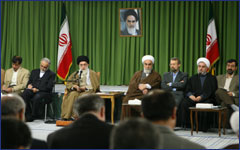
Supreme Leader of the Islamic Revolution Ayatollah Seyyed Ali Khamenei said on Monday that all national economic
activities and planning should be conducted within the framework of the Article 44 privatization plan.
Ayatollah Khamenei issued a decree in early July to privatize state industries by amending Article 44 of the Constitution, which had banned private ownership of state institutions.
In a meeting with the officials in charge of implementing the privatization plan, he said the measures taken to implement the initiative have not been satisfactory.
“This problem has come up due to neglect of the Article 44 policies meant to create a massive economic transformation of the country or because of a lack of understanding (about the plan) among different bodies,” he added.
The Leader called efforts to realize the privatization policies a kind of jihad, saying if officials make serious efforts, the encouraging effect of the privatization plan can be felt in two or three years.
It is necessary to carry out some changes in the structure and rules of the relevant bodies to obtain satisfactory results, he stated.
“The onus is on the three branches of government and all other bodies to carry out the changes,” he noted.
He also said that the economic developments since the victory of the Islamic Revolution in 1979 have not matched the deep sociopolitical developments in the country.
“Of course, important measures have been taken in the economic area, but we should have presented a successful economic model to the world by increasing per capita income and gross national product, eliminating poverty, and establishing justice. We should have proven to the world the capability of the country to boost economic development and establish justice.”
Ayatollah Khamenei said that increasing national wealth and establishing social justice are the main principles of an Islamic economy, adding that every economic approach that would help realize these two objectives is “acceptable”.
He called on officials to make efforts to create a situation where all citizens can invest and increase economic production in order to boost national wealth.
The ground should also be prepared for competent young managers to carry out major projects yielding great profits with the support of various governmental bodies, he added.
“Due to the imposed war (1980-1988 Iran-Iraq war), and the special situation of Iran during the first decade after the victory of the Islamic Revolution, the government’s holdings were expanded beyond the bounds,” he stated.
Through the extensive increase of state-run industries and the lack of privatization, the process continued in the second and third decades, he added.
The most important objectives of the Article 44 initiative are to free the government from unnecessary economic activities, to prepare the ground for economic investment, to determine how to use the privatization revenues, and to task the government with governing, defining policies, and guiding economic affairs.
The implementation of Article 44 policies does not mean “auctioning the country’s public wealth”, but rather transforming the low-yielding assets into an effective wealth that would develop the country’s economy to benefit less privileged social strata, he pointed out.
Creating wealth through legal and legitimate means is acceptable and praised in Islam, Ayatollah Khamenei said, adding that the creation of wealth will eventually make the society rich, and if it is done with the intention of developing the country and helping the poor, it is considered a virtue.
The Islamic system is not against wealth and the creation of wealth, he stressed.
“Fighting economic corruption complements the creation of legitimate wealth, which will prepare the ground for sound economic competition and the implementation of Article 44 policies,” he added.
“It is necessary to revise and reform the laws to combat economic corruption,” he noted.
“Certain people oppose implementation of the (privatization) policies because they are opposed to the economic prosperity and development of the Islamic Republic.
“These people, who are chiefly foreigners, are trying to hold back Iran’s economy to pressure the Islamic Republic through economic means,” he added.
Most of the domestic opponents of the Article 44 plan are those whose benefits would be endangered through its implementation or whose authority would be limited, he added.
“Studying the different aspects of the plan, consulting with experts, and avoiding hasty measures are important. However, the process of implementing the Article 44 policies should be accelerated,” Ayatollah Khamenei emphasized.
He called on officials to pursue the initiative seriously through a plan with a set timetable.
The vice presidents, a number of ministers and ministry officials, the country’s governors, the Majlis Presiding Board, a group of MPs, and other officials attended the meeting.